
Genetic diseases often begin with changes in DNA, but understanding their biological consequences requires looking beyond the genetic variant itself. Researchers need to understand how genetic variation affects genes, cells, tissues, and biological pathways. Single-cell RNA sequencing (scRNA-seq) provides a way to investigate these effects at the level of individual cells, revealing differences in gene expression and cellular states that can be hidden when many different cell types are analyzed together.
Understanding the Link Between Genetic Variants and Cells
A genetic variant can influence biological function in different ways. It may affect a protein-coding sequence, alter gene regulation, or influence when and where a gene is expressed. Importantly, these effects are not necessarily identical across all cell types.
Understanding which cells are affected and how their gene-expression programs change can therefore provide an additional layer of information between genetic variation and disease biology.
Why Look at Individual Cells?
Traditional bulk RNA sequencing measures gene expression across a mixture of cells. This provides valuable information about the overall molecular profile of a tissue, but differences between individual cell populations can become difficult to distinguish.
Single-cell RNA sequencing addresses this limitation by measuring RNA expression at the level of individual cells. This allows researchers to identify distinct cell populations and investigate differences in their molecular states.

Exploring Cellular Identity
One important application of scRNA-seq is identifying which cells are present in a biological sample. Researchers can examine patterns of gene expression to distinguish cell populations and identify genes associated with particular cell types.
This becomes especially useful when studying diseases in which molecular changes may occur primarily in specific cell populations.
From Cell Identity to Cell State
Cells belonging to the same broad cell type can still exist in different functional states. Single-cell approaches allow researchers to examine gene-expression patterns within individual cells and investigate how cellular states vary between individuals, tissues, or biological conditions.
This cellular resolution can help researchers study disease-associated changes that may not be visible when analyzing an entire tissue as a single population.
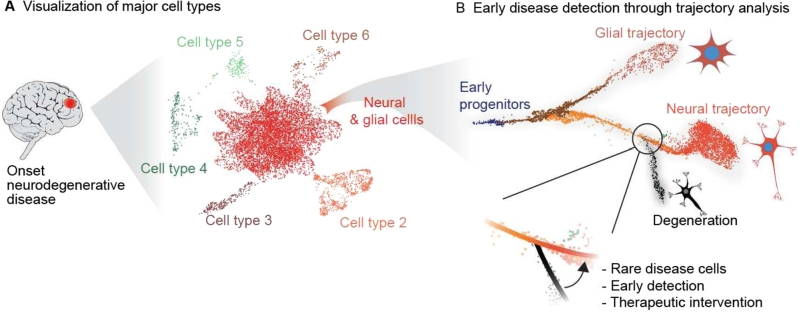
In the picture you can see that Analysis of sc-seq data for early disease detection. (A) The sc-seq data obtained from a brain biopsy can be visualized in the form of a UMAP embedding, where each cell is represented by a dot. Cells (dots) with similar phenotype (transcriptome or epigenetic marks) cluster together, which are assigned to cell types based on prior knowledge. (B) Clusters in A might contain cells undergoing transition, such as differentiation or cell cycles, which can be visualized by means of trajectory analysis. Here, cells that deviate from established healthy trajectories may aid in early disease detection. from
Connecting Genetic Risk to Specific Cell Types
Researchers can combine single-cell RNA-seq with human genetic data to investigate how disease-associated genetic variants relate to particular cell types and biological processes.
For example, researchers have developed computational approaches that integrate single-cell expression data, epigenomic information, and genome-wide association study data to identify cell types and cellular processes associated with disease-related genetic signals.
Studying Cell-Type-Specific Genetic Effects
Genetic variants can have different effects on gene expression depending on the cell type in which they occur.
In one study, researchers used single-cell RNA sequencing to analyze approximately 25,000 peripheral blood mononuclear cells from 45 individuals. They identified both previously known and new cell-type-specific expression quantitative trait loci (eQTLs), demonstrating how single-cell data can reveal regulatory effects that may be difficult to detect using bulk RNA sequencing.
Investigating Disease-Associated Cell Populations
Single-cell genetics can also help researchers investigate which cell populations may be relevant to complex diseases.
By combining genetic information with cell-specific molecular profiles, researchers can investigate relationships between disease-associated variants, gene regulation, and specific cellular contexts. This approach is particularly useful when genetic associations alone do not reveal which cells or biological processes are involved.
Single-Cell RNA-seq and Genetic Disease Research
Together, these approaches create a more detailed path from genetic variation to cellular biology:
Genetic variant → regulatory or molecular effect → altered gene expression → affected cell population → cellular state → biological process
Single-cell sequencing does not independently explain every genetic disease. Instead, it provides an additional layer of biological information that researchers can combine with genetics, epigenomics, and other molecular approaches to investigate disease mechanisms.
Beyond Single-Cell RNA Sequencing
Single-cell RNA sequencing is increasingly being combined with other genomic technologies. Researchers can integrate RNA expression with chromatin accessibility and genetic information to investigate how genetic variation may influence gene regulation in specific cell types.
For example, open-access research has combined single-cell RNA sequencing and single-cell ATAC sequencing (Assay for Transposase-Accessible Chromatin using sequencing), with genetic association data to identify disease-relevant cell types and investigate potential mechanisms underlying complex traits and diseases.
the picture below shows the mechanism of identifying chromatin accessibility using the Tn5 transposase. a Open and closed status of chromatin. b When the chromatin accessibility is increased, the Tn5 transposase transpose in the open chromatin more often than in the inaccessible chromatin. The green/red symbols represents adapters.

Building a Cellular View of Genetic Disease
The growing field of single-cell genomics provides researchers with increasingly detailed ways to connect genetic variation with cellular biology.
Instead of asking only:
Which genetic variant is associated with the disease?
researchers can also investigate:
Which cell types are affected?
Which genes change their expression?
Which cellular states are involved?
Which regulatory mechanisms may be affected?
Which biological pathways could contribute to disease?
These questions help create a more detailed picture of how genetic variation may influence biological systems.
Conclusion
Single-cell RNA sequencing provides researchers with a way to move from a broad view of gene expression toward a more detailed understanding of individual cell populations.
When combined with human genetic data, scRNA-seq can help researchers investigate which cells are involved, how genetic variation may influence gene expression, and which cellular processes may contribute to disease biology.
For genetic disease research, this cellular perspective adds an important dimension to the study of the relationship between genotype, gene regulation, cellular state, and biological function.